Donald and Barbara Borgman and the Translation of the Sanumá New Testament
In 2008, the recently published Sanumá New Testament was distributed to Sanumá believers at Auaris, a remote village along the Auaris River in extreme NW Brazil. The following year, elders were chosen and ordained from Sanumá Christian leaders. Thus, a church was born among a people group who nearly fifty years earlier had never heard of Jesus Christ nor the message of the gospel. These two events represented the culmination of over forty years of work by Bible translator Donald M. Borgman with the assistance of his wife, Barbara. It was an arduous task with setbacks and suffering along the way, yet, one also filled with joy.
Don Borgman grew up at Black Rock Congregational church in Bridgeport Connecticut. The church was pastored by his grandfather, Rev. Charles H. S. MacDowell, who had led the congregation out of liberalism in his early years of pastoring during the 1920s. The church was gospel and mission minded. In his teen years, Don heard stories from visiting missionaries, the Hawkins brothers, with Unevangelized Fields Mission (UFM), about their work among the Wai Wais of southern British Guiana. (For the full story of the Hawkins brothers and the Wai Wais, see Homer Dowdy’s biography, Christ’s Witchdoctor. It is the account of the conversion of the Wai Wai shaman, Elká, and the conversion of the Wai Wai people to belief in Christ.) It was these early stories that ultimately inspired Don to pursue Bible translation among unreached people of the upper Amazon drainage system, specifically the Yanomamis.
Following his graduation from high school in 1949, Don made his way to Moody and then to Wheaton where he completed his B.A. Then, having determined to pursue missionary work, he continued on to Wheaton Graduate School. During these years, he began to take courses at the Summer Institute of Linguistics (SIL) to learn the rudiments of Bible translation. In 1958, Don joined UFM and was on his way to British Guiana. He would spend time with other missionaries in “jungle training”, led by the Wai Wais. It was during this season that Don would make lifelong friends with the famous former shaman Elká and other mission minded Wai Wais.
In 1959, Don joined with several other UFM missionaries to explore and make first contact with various Yanomami groups in the upper regions of the Mucajaí and Uraricoera Rivers of extreme NW Brazil. They were accompanied by Wai Wai believers who were far from home with no knowledge of the peoples and languages they were encountering. With love for the spread of the gospel, they enthusiastically participated in these early expeditions. Among the Yanomami groups encountered were the Nimans, Yanomams, Aicas and Sanumás . Over several years, stations would be established with access only by airstrips cut out of the jungle by the Indigenous peoples of the area. It was during this time that opposition to missionaries by anthropologists and forces within the Brazilian government began to appear. God was working however. At this same time, the Brazilian Air Force was seeking to build airstrips near the Venezuelan border with the help of the local Yanomamis and UFM missionaries. This was under the direction of Colonel Jao Ribeiro. At one point, a message came through to one of the stations that all missionaries were to vacate the region. Colonel Ribeiro was on hand when the message came through. He asked to see it, subsequently tore it up and stated, “You are now under the wings of the Brazilian Air Force.” God’s plans would not be thwarted. Other threats to the missionary efforts continued through the years, and they continue today.
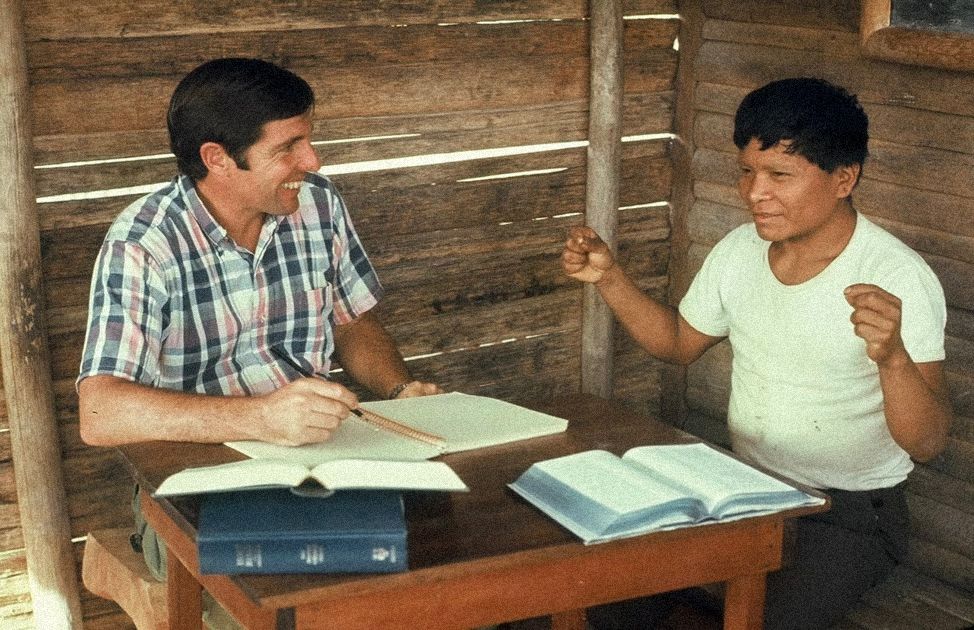
Don spent several years at various Yanomami stations up to his first furlough in 1962. During this time, he continued to learn the Yanomami dialects, especially Yanomam. At one point, he was stranded by himself for several months at Mucajaí Station, his only companions being the Ninam people of the area. This occurred because the Brazilian government had grounded all flights in and out of Yanomami territory and even suspended two way radio contact. At another point, Don spent a year at a remote location called Mount Surucucu. His only companion for the most part, besides the local Yanomams, was a sergeant in the Brazilian Air Force. In 1962, Don was back to the States for his first furlough. He attended SIL for the third time and although the routine was familiar, one thing was not to be commonplace: Don met his future wife, Barbara Hughes! Barb was raised in a Christian home attending a Bible believing church in Hackensack, New Jersey. While attending Christian College, she too gained an interest in missions to unreached people. Since she lived only an hour or so from Bridgeport they were able to see each other often over the ensuing months of Don’s furlough. A romance with a common vision for gospel missions developed.
In 1963, Don was back in Brazil, but this time with the Wai Wais near the British Guiana border helping to oversee the construction of another airstrip in conjunction with the Brazilian Air Force. It was during this time, that Don hatched a plan to try to contact an isolated and dangerous group known as the Atroaris, a Carib speaking people distantly related to the Wai Wais. The Wai Wais had been trying to make contact with this group for a number of years for the sake of the gospel. It would be a joint effort. The expedition was fraught full of risks, for the Atroaris were known for violence and treachery. Many who had entered their lands over the years, had not returned to tell the tale. The expedition would take both UFM missionaries and Wai Wais far from their well-known territory to tributaries flowing directly into the Amazon from the north. They would try to encounter the Atroaris in an area where they frequently looked for turtle eggs at certain points in the year. They never made contact, which as Don stated many years later probably would have ended in their deaths. As he looked back on it, he said that it was a foolish thing to attempt. It would appear that an opening to the Atroaris for the meantime was closed. God had other plans. But what were those plans? A Macedonian call of sorts - back to the Yanomamis and on to the Sanumás! (Eventually, the Wai Wais would make contact with the Atroaris, present the gospel to them and see some come to faith. This story is presented in Homer Dowdy’s book, Christ’s Jungle, the sequel to his Christ’s Witchdoctor.)
In the early years of expedition up the Uraricoera and at the confluence of the Parima and Auaris Rivers, contact was made with people of an Indigenous group known as the Maiongongs or Ye’kuanas as they called themselves. These were Carib speaking people, distantly related to the Wai Wais, who lived in very close proximity to a Yanomami group known as the Sanumás. The missionaries told them that they wanted to make contact with the Sanumás. The Mainongongs wanted medicine and trade goods. A Brazilian Air Force officer told them that if they built an airstrip, he and others would come to visit them and fulfill their desires. The Mainongongs went home, built a perfect airstrip and thus created the possibility of contact with another Yanomami group. Don now turned his attention to the upper Auaris River and the Sanumás. In late 1963, he and another missionary flew into the new airstrip and proceeded on an exploratory expedition down the Auaris River to the Uraricoera to make contact with various Sanumá villages. A new area and people were now open to the gospel.
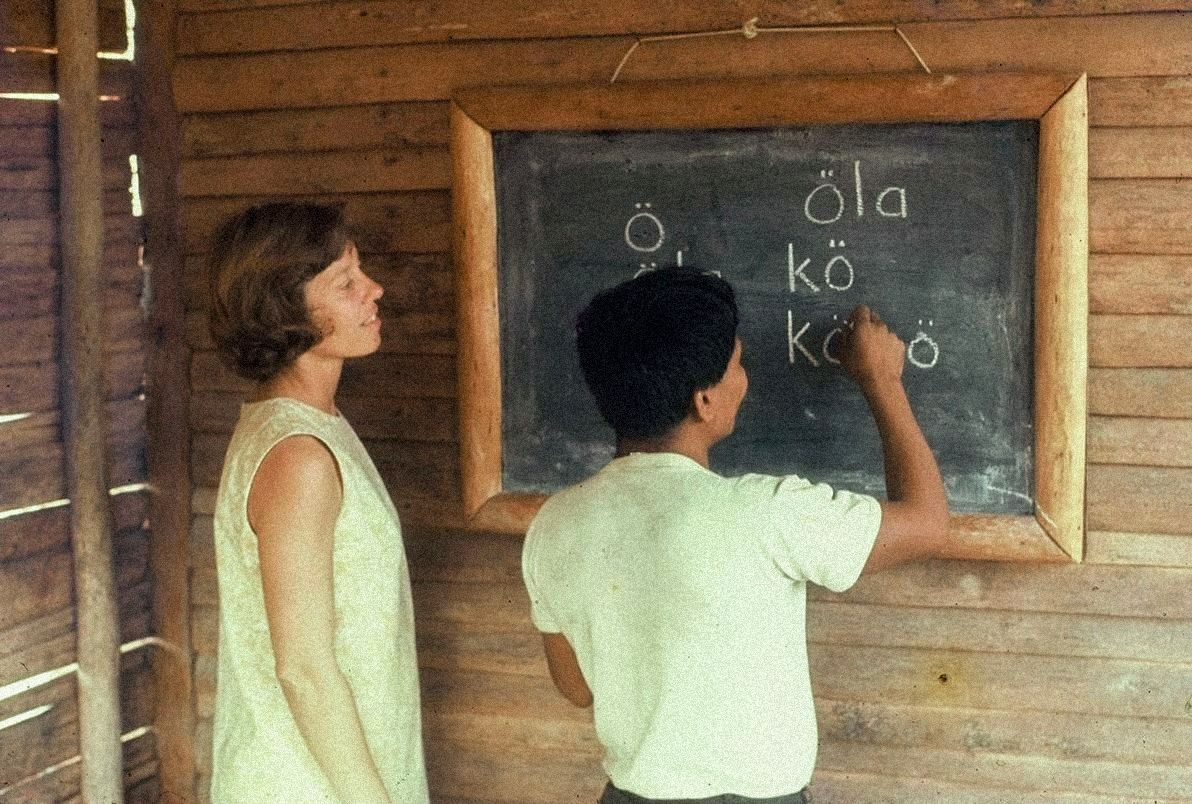
In November of 1964, after Barbara Hughes had been in Brazil for a year learning Portuguese, she and Don were married in Nova Friburgo near Rio de Janeiro. Within two months, the newly wed couple was now settling in at Auaris Station among the Sanumá people. Thus started a forty year effort to learn and translate the scriptures in the Sanumá language. The early years at Auaris required considerable adjustment, especially for Barb who had never been in this type of environment. Between constant peering eyes, unending “camping” as she put it along with isolation - 300 miles by air to the nearest town, Barb had to endure many challenges. The language barrier was the greatest challenge. Within a year, a son, David, was born. A couple years later, Stephen was born and then a daughter, Andrea, in 1970. Language breakthroughs occurred over time with Don slowly piecing together the Sanumá language for basic communication and translation work. Barb, with a background in elementary education, taught some of the local Sanumás how to write basic words and phrases that she learned. On top of the living conditions and isolation, Don and Barb also had to tend to sick Sanumás and Maiongongs dealing with outbreaks of flu, malaria and even measles at one point. They had to learn how to give injections, even though they were not professionally trained. This occurred until other Brazilian missionaries and a nurse arrived to take up residence at the station. The grueling work on all fronts continued.
At the same time, Don was able to get to know some of the Sanumás quite well as friendships developed. With them, he was able to share the gospel although any fruit was still many years away. One pivotal friendship made was with a Maiongong man by the name of Lourenzo who had a Sanumá wife. He was highly respected by both groups and it was through his friendship that Don’s standing and message among the people was elevated and validated. Lourenzo would eventually profess faith as did his children. Both Lourenzo and his son, Alberto, would die tragic deaths in 1990 at the hands of illegal gold miners operating in the region. Had God not providentially hindered Don from being in the Sanumá village at the time, he too may have been killed.
Tragedy struck Don and Barb’s family in 1971 with the death of their oldest child, David. He was bitten by a snake that had been given him by a Sanumá girl who mistook it for a harmless, nonvenomous type. The Sanumá children loved playing with David. The girl apparently mistook it for the non-venomous false coral, but sadly, it was an actual coral. The entire village was devastated. It was a tragic incident that must have weighed heavily on this young girl. It was a devastating loss that has remained with the Borgmans throughout all their years. When asked by the author if he and Barb considered leaving the mission field after this occurrence, Don’s response was that it was never a consideration. They were committed to seeing the work through out of love for the Sanumá people and their Savior. A couple years after David’s death, another daughter, Darlene, was born.
During the ensuing years, the family would mainly live in Boa Vista with Don making regular visits out to the Sanumás for translation work as well as teaching and discipling new believers. The first professions of faith and baptisms came in the 1980s, twenty years after their work started among the Sanumás. By the 1990s, Don and Barb were residing in Florida with Don making frequent trips to the Sanumás. During this time, he was able to gather a willing cadre of Sanumás to help with translation work. The Sanumás were taking the translation work on for themselves and would be integral in the completion of the work. Some of those who did the work would later become leaders of the Sanumá church. As mentioned earlier, the Sanumá New Testament was distributed to Sanumá believers in 2008 and a year later, the Sanumá church was born. By this time, Don and Barb were retired, and living permanently back in the States. Don, however, continued to translate Old Testament sections as well as teaching material for the fledgling church.
How can the lives of Don and Barb Borgman be characterized in their lifelong effort to help fulfill the great commission? Vision for the expansion of the Kingdom to every tribe and tongue; commitment and courage in the face of hardship and suffering; love for the Savior and a people upon whom God had placed His love - particularly the Sanumá people. God’s grace was extended to a people through the faithful and sacrificial work by these two servants of the Lord.
In late November of 2025, the Lord took Don Borgman home to his eternal rest. Barb remains. She prays for the Sanumá people and church whom she knows and loves.