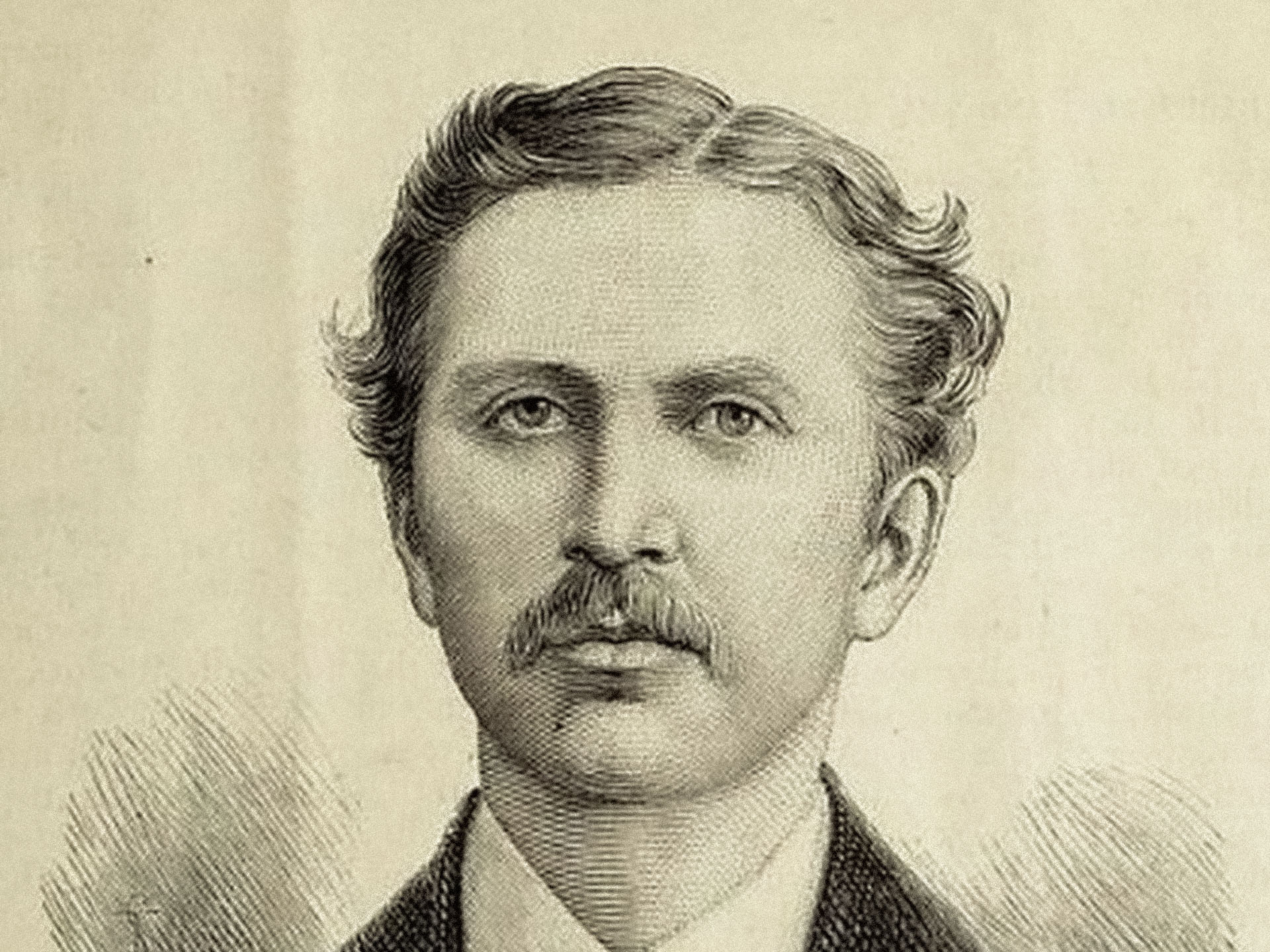
Early life
Alexander Murdoch Mackay (pronounced Mac-kie) was born on October 13, 1849 in the village Rhynie of Aberdeenshire, Scotland to his parents, Rev. Alexander Mackay and Margaret Lillie.
For 14 years, Mackay received personal guidance from his father, a minister in the Free Church of Scotland, and often accompanied him on daily walks around the village and participating in daily activities. Mackay’s father traced pictures, formulas, and ideas for his son into the dust with his walking stick. One morning, Rev. Mackay told his son the story of David Livingstone and traced the route of the Zambesi River running down from the heart of Africa into the Indian Ocean. Perhaps, this small lesson at his father’s side foreshadows Mackay’s missionary work, following in Livingstone’s footsteps.
Mackay loved literature and learning, and was instinctively drawn to the mechanics of life, such as engines and trades. He often walked four miles each way to the nearest train station to get a quick, two-minute glimpse at the powerful engine. His regular haunts, instead of playing with his friends, were the local trades such as the blacksmith, the currier, and the carpenter. Mackay entered the Grammar School at Aberdeen to continue his education. The more he learned, the more his love of machinery and engineering grew. He spent his free time observing the local shipyard.
At age 16, Mackay lost his mother, who hoped he would follow his father and enter the ministry. Upon her death, a family friend gifted Mackay his mother’s Bible (her husband’s wedding gift). She wrote an inscription to her son that charged him to “search the scriptures”. These deeply loving words feels reminiscent of Monica’s devotion to her son, St. Augustine. Mackay continued to relish the Bible and seek spiritual strength and knowledge from it for the rest of his life.
Later Education, Work, and Missionary Call
In the fall of 1867, the Mackay family moved to Edinburgh where Mackay entered the Free Church Training College for Teachers, thriving as a star pupil. Particularly talented in drawing, Mackay received a prize from the Kensington Department for Freehand Drawing, Practical Geometry, Perspective, and Model Drawing. He next studied at Edinburgh University for three years and pursued Mechanics, Mathematics, Natural Philosophy, among others. He taught in the university and spent copious amounts of time under the tutelage of professors. During his afternoons, he travelled to the engineering works, practicing hands on skills necessary for engineering. Though he was extremely busy and driven, he set apart each Sunday for time with the Lord and the church where he taught Sunday school for children.
On November 1, 1873, Mackay set out for Germany to be a draughtsman (engineering technician) and study the language. The hours were grueling and his colleagues depressed him with their “heathen” actions. Mackay desired to merge his spiritual and practical spheres of life to serve his Lord the best, viewing missionary work as the means. Originally, he felt called to be a missionary to Madagascar, but doors were closed and he wondered what path the Lord wanted him to follow.
In late 1875, Mackay read a letter in the Daily Review from Sir Henry Morton Stanley, the man who found Livingston in the heart of Africa:
King M'tesa of Uganda has been asking me about the white man's God. ...Oh that some practical missionary would come here. M'tesa would give him anything that he desired— houses, land, cattle, ivory. It is the practical Christian who can ... cure their diseases, build dwellings, teach farming and turn his hand to anything like a sailor—this is the man who is wanted. Such a one, if he can be found, would become the saviour of Africa.
Mackay was struck with Stanley’s desire for a “practical Christian” who could “turn his hand to anything.” He knew he had a clear call to Uganda. Offering himself to the Church Missionary Society in London, he wrote, “My heart burns for the deliverance of Africa, and if you can send me to any one of those regions which Livingstone and Stanley have found to be groaning under the curse of the slave-hunter, I shall be very glad.” Within a few months, Mackay departed with other young men on a ship heading for Zanzibar. His missionary journey had begun.
Missionary Work in Uganda
After arriving on Zanzibar’s coast, Mackay and others set off into the heart of Africa, heading for Lake Victoria Nyanza. Hundreds of miles from the coast, Mackay contracted a fever and almost died. He was carried back to the coast to recover. After regaining his strength, he built a 230 mile wagon road to Mpapwa with a pick and an axe in 100 days. In a letter home, he wrote, “This will certainly yet be a highway for the King Himself; and all that pass this way will come to know His Name.”
The next months were filled with trouble, toil, and heartache. Mackay found the boat, Daisy, that his comrades had abandoned. He rebuilt Daisy himself and set sail down the river again, only to get shipwrecked. After spending months rebuilding his boat a second time, using his engineering talent, Mackay finally arrived at the capital of Uganda. King M’tesa gave the new missionary land to build on, enough room to build a smithy and workshop. He began serving the natives practically, building them huts, a well, and farming tools, while simultaneously teaching them about the gospel. They were astonished at what he was able to make with his hands, attributing it to witchcraft. They named him Mazunga-wa-Kazi—the White-Man-at-Work.
Mackay served the Ugandan people, physically and spiritually for years. He translated the Gospel of Matthew into the Luganda language and developed good relations with King M’tesa, creating a permanent missionary station in the region. When King M’tesa died in 1884, however, the king’s successor persecuted the Christian converts and ordered a massacre of the Christians in the area in the spring of 1887. The remaining Christians went into hiding or fled. Mackay, suffering from sickness, witnessed the martyrdom but continued to work despite increased danger.
Finally, after terrible pressure from Arabs working with King Mwanga to drive Mackay away, Mackay left the missionary base and sailed 223 miles to the south end of Lake Victoria where he remained the rest of his life. Though he was away from the missionary base and Christian community, Mackay continued his service for the Church through letter writing, hospitality to other missionaries, and translation.
Mackay succumbed to fever caused by malaria on February 4, 1890, dying at age 40. He was initially buried on the shores of Lake Victoria, and then reburied at the cemetery in Kampala, the capital of Uganda. The Church Missionary Society’s minutes record that, “During the whole period of nearly fourteen years, [Mackay] never once left the shores of Africa.” This is a testament to Mackay’s tireless dedication to the Kingdom of God and Uganda. He fed the souls and the lives of the Ugandans, much like our Lord Jesus’s ministry on Earth.