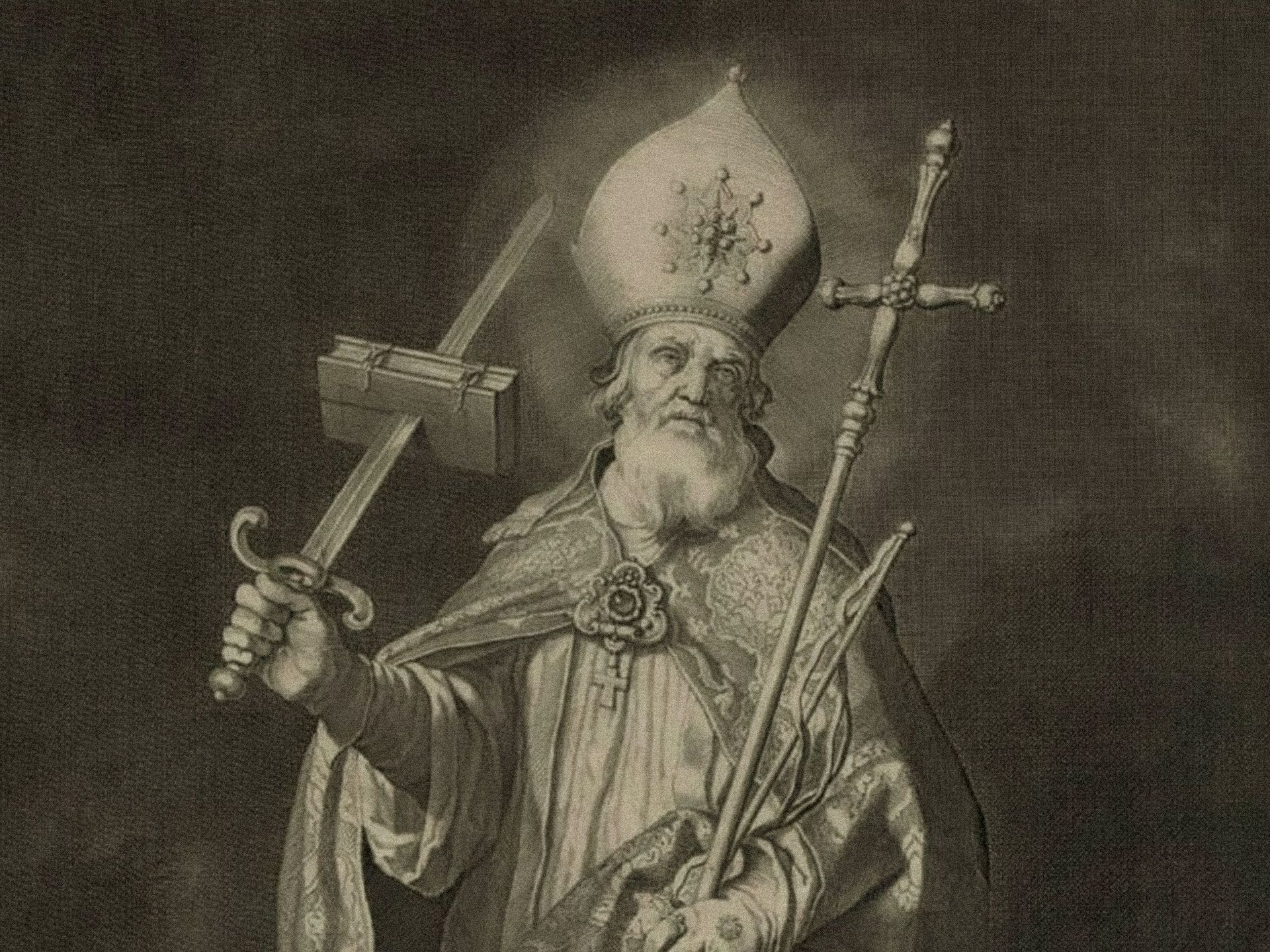
In 675 AD, a son was born to a noble family of Wessex. They baptized the child and named him Wynfrith. From a young age, the boy “burned with a desire for monastic life,” as he later said in a letter. But a monastic life meant renouncing family and inheritance. Wynfrith’s father opposed the idea of such a life for his favored son. He preferred his son embrace a secure existence with honor, family, and political connections over a strict monastic upbringing. Employing manipulations and threats, Wynfrith’s father tried to break his son’s resistance. When Wynfrith’s father was struck by a severe illness, he took it as a sign from God that he should not have opposed religious training for Wynfrith. He relented. Wynfrith was sent to the monastery at Exeter to be educated by Abbot Wolfhard.
At Exeter and later Nursling, Wynfrith excelled at his studies. He did not find his teachers too strict or the education too rigorous. Nursling was known for rigorous and high quality training and it was there that Wynfrith underwent studies in grammar, Biblical exegesis, and preaching. Because of his diligence, his teachers encouraged him to pursue higher studies and made him an educator at the school. At age 30, he became a monk with a promising career as an educator. Wynfrith, however, had a vision for another place.
In 716, when Wynfrith was 40, now a renowned educator, author, and head of the monastic school, he approached his superior and requested permission to evangelize the Frisians (modern day Netherlands) and Saxons (now a part of Germany). Because Wynfrith was considered integral to the educational success and reputation of the monastery, the head abbot refused his request. As with his father, Wynfrith persisted until permission was granted. He left for the North Sea coast later that year, supplied with companions and commendatory papers. He encountered war between pagan King Radbod and the Frankish ruler in Frisia. Hostile to Christianity, Radbod persecuted believers, burning down their churches. Eventually, Wynfrith was forced to return to England in failure. Back at Nursling, upon the abbot’s death, Wynfrith was encouraged to take his place. With a heart set on evangelizing the pagans, he declined and left for Rome and a meeting with Pope Gregory II. Pope Gregory II gave Wynfrith an official missionary commission and renamed him Boniface, after a famous 4th century martyr. Appointed Missionary Bishop to Germania, Boniface left Rome for the new mission field, Thuringia. While traveling, he heard that King Radbod was dead and conditions were more favorable to gospel work in Frisia. Boniface returned there instead of going to Thuringia. For three years he worked alongside Willibrord, Apostle to Frisia, Bishop of Utrecht. Aging, Willibrord wanted to make Boniface a bishop and have him as his successor. Boniface felt that his papal calling was to the uncivilized tribes of Germania and not to an established church. He left for Hesse, in central Germany.
Hesse was largely forested, with small settlements of people who had embraced syncretism, joining parts of Christianity with their old pagan gods. They had been baptized but continued sacrifices to trees and springs of water. Boniface countered this with preaching, teaching, and catechising. He lived under constant bodily threat from pagan chieftains and hostile locals, eventually obtaining an order of Safe Conduct from Charles Martel, the mayor of the palace, at the request of the Pope. Boniface and his companions moved between villages and estates, preaching, teaching, catechising, and baptizing. He established a monastery at Fritzlar that operated as a base for missions, prayer and liturgy, and storage of supplies. From that monastery went a continual flow of workers to preach. Boniface studied to learn the different Germanic dialects for his preaching. He recruited more Anglo-Saxon workers to come live at the monastery and participate in establishing and organizing a church for Rome among the Germanic people.
He and his companions worked continually to disciple new believers and confront syncretism. In Hesse stood a center for pagan worship, the Donar Oak. Here the people made secret and public sacrifices to Thor and held divinations. To prove the impotence of the false gods, Boniface decided to chop down the oak. The story goes that he was midway into felling the great tree when a severe wind began to blow and toppled the tree in four pieces. When absolutely nothing happened, and Thor did not strike Boniface with lightning, the pagan locals who had been resistant to the gospel believed and were baptized. Boniface and his companions turned the lumber from the tree into boards and built a church. His reputation for being one to confront centers of cult worship spread throughout Germania.
In the following decades, Boniface and his companions worked in Hesse and in Thuringia. Boniface established a diocese to organize the Germanic church. He orchestrated the establishment of a monastery at Fulda which became a center of spiritual learning. He was appointed as the Archbishop of Mainz, making him the primate of the German church. In his late 70s, he resigned his status as archbishop and traveled a final time to his first missional love, Frisia. One morning, waiting to confirm a group of new believers in Dokkum, the group was attacked by a group of pagans or bandits. Boniface refused to resist with violence. He and 52 of his followers were martyred that day. His body was carried to the monastery at Fulda and buried there.
Boniface is remembered today for his reform of the Germanic church, his boldness in preaching, and his persistence in bringing Christianity to pagan tribes of his day. There is also much of his life that needfully falls under critique - he taught that baptism was necessary for salvation, encouraged submission to the Roman papacy above all else, strengthened Frankish ties to Rome, harshly advocated and argued for celibacy, even encouraging priests and bishops who were married to send away their wives and begin penance. He was known for being ruthlessly legalistic and finding heresy against Rome under every bush, once even requesting Rome condemn a monk for theorizing that humans lived on the other side of the globe. With all his flaws and blind spots, Boniface remains a pillar of missions in the Dark Ages. His efforts drove Christianity deeper into pagan Europe. His life serves both as a demonstration of how God can use fallible humans and a cautionary tale of misplaced zeal and devotion.