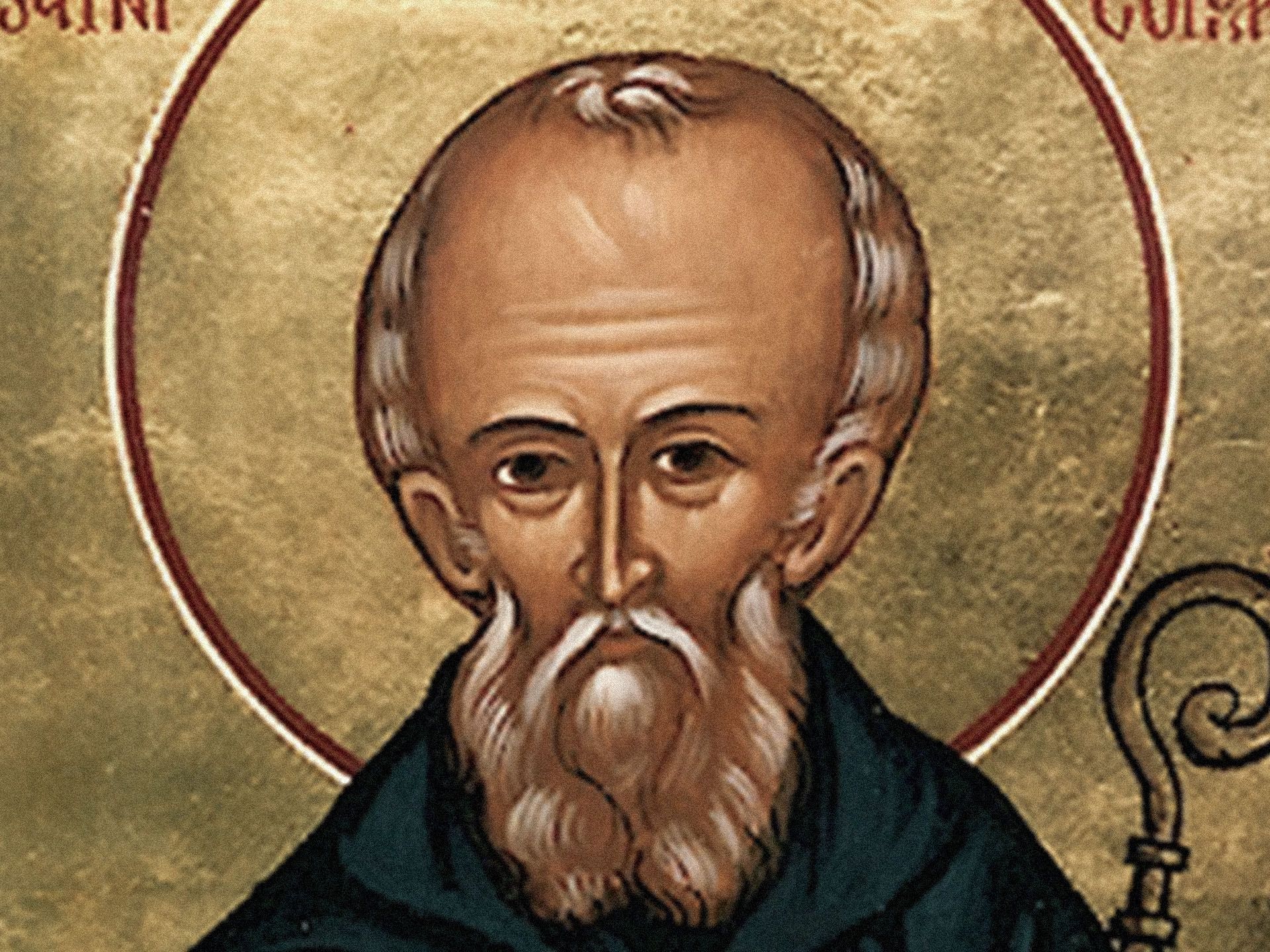
Early Life
Columba of Iona was born into a noble family around 521 AD in what is now County Donegal, Ireland. Tradition gives him the birthdate of December 7. According to the customs of the day, Columba was raised by a foster-father priest, and he demonstrated an interest in spiritual matters from a young age. Columba’s full Irish name was Colum Cille mac Feidlimid. “Columba,” which means “dove of the church,” was likely a name given to him at his baptism.
As he grew older, Columba studied at the monastic school of Cooley where he became a deacon and then at the Clonard monastery, where he was eventually ordained as a priest in 551. During this time he founded several churches and monasteries, including those at Derry and Durrow, as well as a religious community at Kells.
Exile to Iona
In 563, Columba, along with twelve fellow monks, traveled to Iona, an island in the New Hebrides off the west coast of Scotland. History is unclear as to Columba’s exact motivation in moving to Iona. According to legend, Columba was exiled because of the role he played in instigating a war between his clan and the high king of Ireland. The dispute allegedly centered on headstrong Columba’s insistence that a copy he made of Finnian of Moville’s devotional manuscript should belong to him. The high king was asked to settle the men' s argument, and he famously decided in favor of Finnian with the comment: “To every cow belongs her calf, therefore to every book belongs its copy.” Many believe that Columba then incited his kinsmen against the high king, causing a conflict that resulted in the deaths of several thousand men.
A synod the following year attempted to excommunicate Columba, but eventually retracted charges when the respected St. Brendan said he had seen a column of light before Columba and believed he was still in God’s favor. Whether Columba was forcibly exiled or whether he imposed exile on himself as penance for his sin, he ultimately landed at Iona and established a monastery there that became known for preserving Celtic Christian heritage.
Conversion of Scotland
Initially, the monks at Iona ministered in the region of Dalriada that contained many Celtic Christians in need of discipleship. However, Columba eventually traveled to mainland Scotland to speak with King Bridei of the Picts. According to tradition, King Bridei converted to Christianity when he witnessed the miracle of his barred gates opening when Columba made the sign of the cross before them. Bridei’s conversion became the start of the larger conversion of Scotland to Christianity.
Columba spent the next thirty years traveling through Scotland, preaching and teaching and establishing churches and monasteries. When not traveling, he resided at Iona, living the humble life of a monk. In 597, he died peacefully at home in Iona. According to the hagiographer Adomnan, Columba experienced heavenly visions telling of his coming death. He is remembered for his large role in bringing the gospel to Scotland and is considered a revered saint in several church traditions. It is believed that the Book of Kells–an illuminated manuscript containing the gospels–originated in Iona during Columba’s lifetime. In 1938, George MacLeod established an ecumenical Christian community at Iona, in honor of Columba’s faithful service to God.
Be Thou a bright flame before me,
Be Thou a guiding star above me,
Be Thou a smooth path before me,
Be Thou a kindly shepherd behind me,
Today, tonight, and forever.
(prayer attributed to Columba)