Early Life
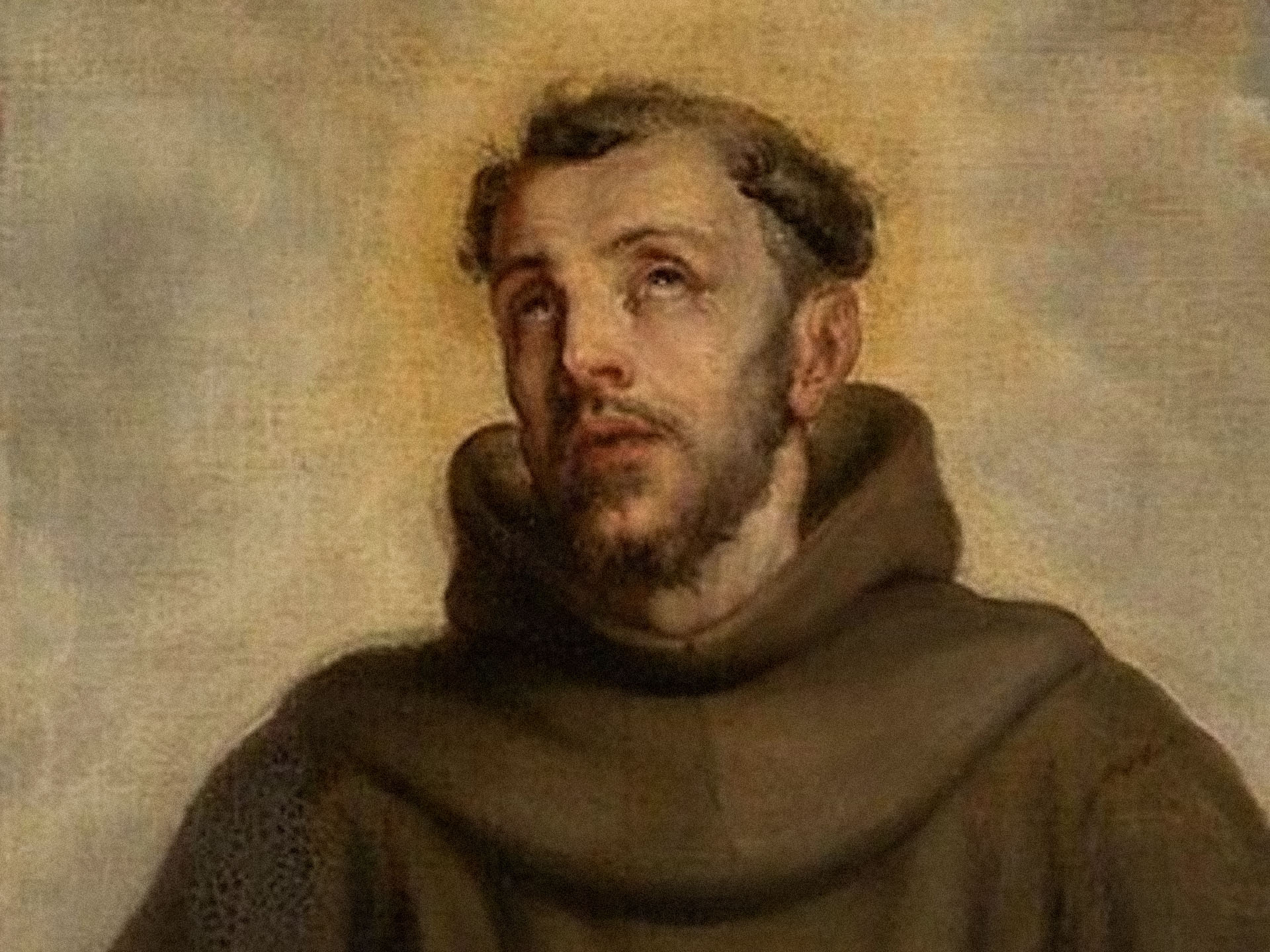
Giovanni di Pietro di Bernardone was born in the Italian town of Assisi. He was the son of an affluent cloth merchant named Pietro and his wife, Pica. His father loved French culture and was, in fact, on a trip to France when his son was born. Pietro’s love of France may have led to Giovanni’s being renamed by his father “Francesco” or “the Frenchman” (from which we get Francis).
Young Francis loved song and poetry, both of which found expression in the troubadours, a group of traveling poets who sang about medieval knights and their victories. He dreamed of becoming one of these knights, and that dream morphed into a desire for war-won glory. So, when Assisi went to war with the neighboring city of Perugia, Francis joined the battle. Many of his comrades were killed, but Francis was captured and imprisoned for a year. Some say that he only survived because of his father’s value: he could be ransomed, whereas his poorer friends could not. That experience—both the isolation in prison and an accompanying illness—set him on a path of internal transformation.
Building the Church
Francis’s health never fully returned, even after he was released. He became restless and soon went on a pilgrimage to Rome, which would prove to be a defining journey for him. While there, he was filled with compassion for the poor. He even exchanged clothes with a beggar to experience a life of poverty. Soon afterward, while praying before a crucifix in the church of San Damiano, he reportedly heard Christ say, “Francis, go and repair my house, which is falling into ruin.”
At first, he took the words literally and began rebuilding the small chapel from stone, which he had to hew himself and carry to the church. But that laborious project took root in him and grew to something greater: a passion to renew the church itself through radical obedience to the gospel. Much to his father’s disappointment, Francis gave up the family business and let go of his riches. In a famous incident at the town square, where Francis was charged with stealing his father’s goods and selling them to rebuild San Damiano, he removed all his clothing (afforded to him by his father’s wealth) and said that his true Father was in heaven. It was a declaration that his needs were divinely provided for. It was also a definitive break with his former privileged life.
Francis’s fervency for Christ-like poverty and humility sparked a movement that would eventually blossom into the Franciscan Order. As he preached repentance, simple living, and joy in the presence of God, the movement spread. Not so unlike the troubadours he once admired, Francis and his followers wandered barefoot through the countryside singing hymns, caring for the sick, and proclaiming the love of Christ. For people today, his message seems strikingly direct: the gospel meant living like Jesus—poor, humble, and utterly dependent on God.
A Love for Nature
Perhaps Francis is most well-known today for his love of nature. He saw every living thing as a fellow creature praising its Maker. Birds, wolves, and even the sun and moon found their way into his famous poem “Canticle of the Creatures,” one of the earliest poems in the Italian language. He referred to animals in familial terms, as “brother” and “sister.” His gentle reverence for nature made him a forerunner of Christian ecological thought (i.e., Christian care for the environment) centuries before the term existed. His love of nature was so famous and praised that he was named the patron saint of animals and ecology by the Roman Catholic Church.
Later Life
In 1209, Francis traveled to Rome, the city that gave rise to his identification with the poor. This time, he was traveling to seek papal approval for his brotherhood’s simple rule of life (a “rule of life” is a monastic way of living, with certain values and practices). Pope Innocent III eventually gave his blessing on what he called “The Order of Friars Minor.” “Minor” in this case meant “lesser brothers,” a nod to Francis’s humility.
Later in life, Francis sought solitude and prayer in mountain retreats, desiring deeper union with Christ. This modeled Christ’s own repeated retreats to deserted places and mountain tops for prayer. He died in 1226, at the age of 44, lying on the bare earth and reportedly singing Psalm 141: “With my voice I cry to the Lord.”
Contribution to Missions
Missions is a movement to spread the gospel where it has not taken root, and Francis certainly did that. He rekindled the church’s witness to the world and fervor for Christ through the personal embodiment of Christ’s humble life. He embraced radical discipleship, which naturally blossomed into a mission. For him and his followers, evangelism was not merely preaching doctrines; it was showing the world the beauty of Christ’s humility and love.
Francis also inspired early missionary ventures beyond Europe, in Morocco, Spain, and the Near East. Many of these missionaries faced martyrdom. In 1219, Francis himself traveled to Egypt during the Crusades to meet Sultan al-Kamil, the fourth Ayyubid sultan of Egypt. Risking his life, Francis crossed enemy lines to speak with the Muslim ruler about peace and faith. Though the Sultan did not convert, the encounter became a lasting symbol of interfaith respect and courage.
By the time of his death, thousands of Franciscan friars were spreading throughout Europe, preaching repentance and caring for the poor. The Franciscan vision—simple living, compassionate self-sacrifice, and love for creation—became a quiet revolution that continues to shape Christian missions.
While Francis of Assisi left no grand theological treatise, and no book to summarize his thought, his own life was a sort of living book, a sermon in motion. Few others followed Christ’s words on generosity with such passion: “Freely you have received; freely give” (Matthew. 10:8). Through his example, the church rediscovered that true mission flows from joy—joy in poverty, joy in service, and joy in the presence of a God who became poor so that we might become rich.