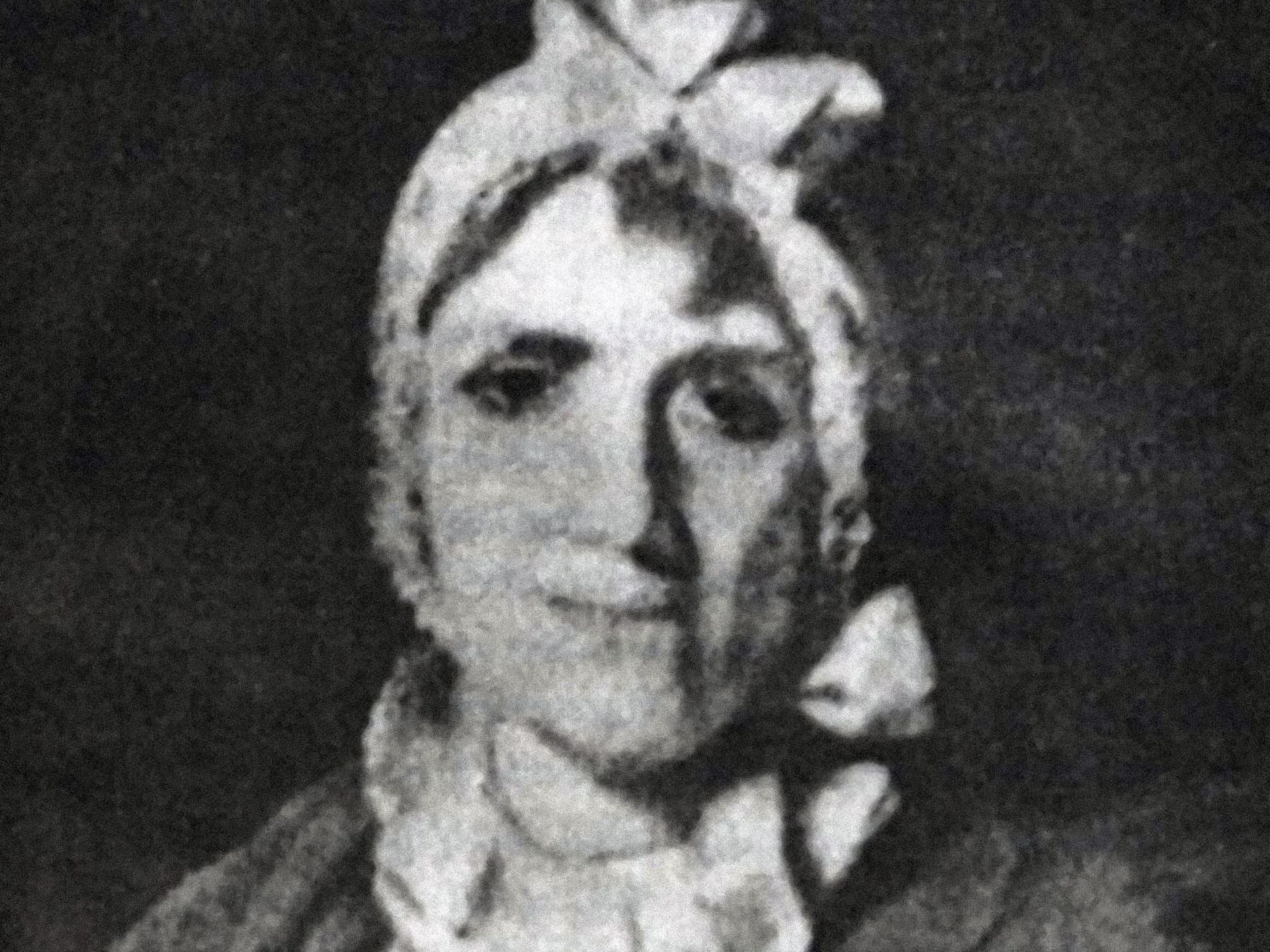
Hannah Marshman was born to the Shepherd family in 1767. Daughter to a farmer, her maternal grandfather had been a Baptist pastor for years, and the family was well known within Baptist circles.
At age eight, Marshman’s mother died, and she was sent to live with her grandfather in Wiltshire. The retired minister and scholar educated his granddaughter in all manner of subjects, in which she was exceptionally gifted.
During her teen years, Marshman suffered from poor health and was confined to bed for a few years. While recovering at age 15, her heart grew soft to the gospel, and the young girl became a Christian. Once she regained her health, Marshman was baptized. Later, she called those years of sickness some of the happiest in her life because it had allowed her to experience God’s abundant mercy.
In 1791, she married John Marshman, a gifted scholar from humble beginnings, and the two moved to Bristol. There, Marshman’s husband worked as a teacher in a small Baptist charity school. News began to travel of a mission work in India and the need for more workers. The famous William Carey was consumed by his many projects and requested additional assistance. The couple quickly came to an agreement: they would apply to join Carey in India.
In 1799, with two children in tow, the Marshman’s set sail on a long laborious journey. After months of travel, the ship was forced to dock in the Danish settlement, Serampore (north of Calcutta) in order to avoid a possible French naval attack. The family’s travel permits then were denied due to The East India Trading Company. The powerful joint-stock organization was hostile to missionaries. So, they were forced to remain in Serampore.
A few months later, in 1800, William Carey joined them with his family, and the large group of missionaries made a home together under one roof. Most of the domestic duties fell to Marshman, who came to be known as “mother of the mission.” She ran the communal household and cared for all the children.
Carey’s wife was mentally ill and unable to contribute much. Carey himself neglected his children, being occupied with his work. The four sons were dirty, uneducated, and poorly mannered. Marshman wrote about Carey, “The good man saw and lamented the evil but was too mild to apply an effectual remedy.” She and her husband were appalled by the situation, and took the boys under their wings, raising them up to be godly gentlemen.
Soon, more team members joined, but her work did not seem to be alleviated. Instead, Marshman looked after the pregnant wife of one missionary and soon, the additional infant. As her husband studied local languages, the need for education in the villages also became apparent. So, Marshman, with the support of the team, opened two boarding schools. Her children (they would have 12 altogether, though some would die in early childhood) also attended these schools and became fluent in Bengali.
As the work expanded, more missionaries began to arrive, but some were unwilling to live in community with locals or the original mission team. One missionary demanded his own house, stable, and servants, even though everyone else lived under the same roof.
In 1800, she started a day school, which she operated as well as the other two boarding schools. This work, along with her position as mother and caretaker, made Marshman a role model for many women in India. She was an educated, hardworking, loving wife and mother, successful school operator, and the first female missionary to India.
Marshman passed away in 1847, 10 years after her husband. Now the schools she founded have expanded into many more. Her son John, who went on to be a prolific linguist like his father, wrote this tribute about his mother: “A woman of feeling, piety and good sense, of strong mind … fitted in every respect to be an associate in the great undertaking to which the life of her husband was devoted — and withal so amiable a disposition that nothing was ever known to have ruffled her temper.”