Early Life
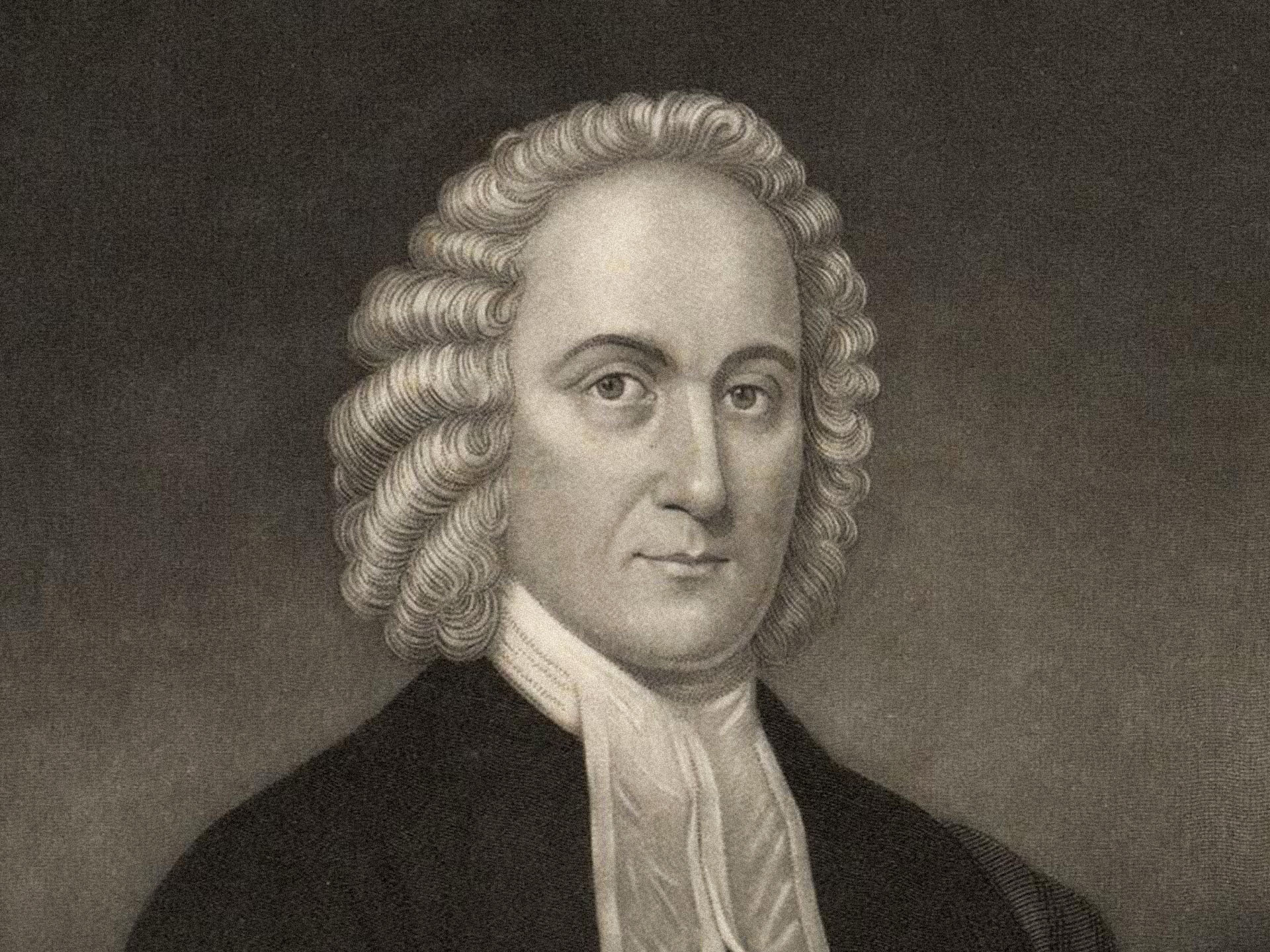
Jonathan Edwards was born on October 5, 1703, in East Windsor, Connecticut. He was the only son among eleven children to Timothy and Esther Edwards. His father was a respected Puritan pastor in East Windsor, and his mother came from a long line of ministers, so faith and learning were woven into his upbringing. From his earliest years, Jonathan’s mind was alive with curiosity and attention to detail. At just thirteen years old, he entered Yale College, where he immersed himself in theology, philosophy, and natural science—especially the thought of the English scientist Isaac Newton. Edwards’s intellect was immense, as was his spiritual sensitivity. As an avid reader, he would constantly take notes on what he read, cataloguing and processing new ideas in his journals.
Edwards’s early writings show a heart enraptured by God’s greatness and sovereignty. This can be seen in his notebooks on “The Mind,” “The Beauty of the World,” and “Miscellanies” on theology. For him, the universe was a vast and intricate display of divine beauty. But, of course, not everyone perceived this beauty. Edwards would come to argue against materialists and atheists of his day, those who were blind to God’s glory. In order to see the glory of God in all things, Edwards argued that a person needed a heart renewed by grace. That conviction would shape his entire life’s work. Perception of the world and God’s involvement in it was a matter of the heart.
Education and Pastoral Work
After completing his studies and serving as a tutor at Yale, Edwards became an assistant to his grandfather, the renowned pastor Solomon Stoddard, in Northampton, Massachusetts. The congregation was the most prominent one outside of Boston. When Stoddard died in 1729, Edwards succeeded him. While the congregation prospered, its spiritual vitality began to wane. What could address that? As it turns out, the answer was Edwards’s preaching. His sermons were carefully reasoned, reflecting his own intellect and sensitivity, but they were also filled with concrete imagery and theological depth. He is said to have spoken with a quiet intensity—something that stirred both minds and hearts in his congregation.
By the early 1730s, his Northampton congregation experienced a remarkable awakening. Edwards’s preaching on justification by faith and the need for personal conversion ignited conviction among his listeners. Young and old alike responded in the now famous portrayals from The Great Awakening: weeping, passionate prayer, and ecstatic rejoicing. The movement swept across the American colonies, renewing churches and reorienting lives toward Christ.
Edwards’s own reflections on these events would become great works in American religious history. His A Faithful Narrative of the Surprising Work of God (1737) was one of the first theological treatments of revival. Later, his Treatise Concerning Religious Affections (1746) explored how faith manifests itself in someone’s heart. Edwards insisted that true religion lies not in understanding and accepting doctrines but in the stirring of “holy affections.” By this he meant that our inclination or will is moved toward God in being pleased or displeased, approving or rejecting. In other words, true religion included our soul’s willing response to God’s truth and glory, not merely intellectual assent to a set of doctrines. The goal of human life was thus not happiness or self-love (two popular theories at the time), but the glory of God, which was most satisfying to human creatures made in God’s image. One can see the influence of Edwards on the thought of John Piper today, whose central message has been that “God is most glorified in us when we are most satisfied in him.”
Edwards’s most famous sermon, “Sinners in the Hands of an Angry God” (1741), preached in Enfield, Connecticut, is a striking display of his rhetorical ability. While some readers today dismiss the sermon as “fear-mongering” or “all fire and brimstone,” it is actually a rhetorically urgent appeal to grace. His vision of divine wrath, in other words, was always balanced by a profound joy in and gratitude for mercy. He aimed to awaken hearers to their peril so that they might flee to Christ, the one who could save them.
On the popular level, Edwards is caricatured as a theologian of God’s wrathful judgment, but he is more consistently a theologian of beauty and joy. He saw God’s glory as the ultimate end of creation and salvation. Humanity’s happiness, for him, was inseparable from delight in God. And it’s this emphasis that made his life and teaching extend beyond pastoring and into the mission field. His days at Northampton, as it turns out, were numbered.
Missions and Writing
In 1750, tensions rose in his congregation because Edwards wanted to tighten the standards for admission to the Lord’s Supper. Who should be able to take communion? Edwards insisted that only those who had professed saving faith should partake, not those we were marked as part of God’s covenant people via baptism but who had yet to make a public profession of faith. Many objected, and after much dispute, he was dismissed from his pastorate. Though deeply wounded, he eventually accepted this as God’s providence, solidifying his belief in divine sovereignty. His heart then turned toward the frontier mission field: Native Americans.
In 1751, Edwards accepted a call to serve as a missionary to the Mahican and Mohawk peoples in Stockbridge, Massachusetts. Though it seemed a radical move for him, he took it as an opportunity to embody the gospel’s global reach. It was also a time of writing for him. While ministering to the Native Americans, he wrote some of his greatest theological works, including Freedom of the Will (1754) and The Great Christian Doctrine of Original Sin Defended (1758). While in Stockbridge, he supported efforts to translate Scripture into native languages and provide education for both Native and colonial children. Given his childhood and background, this is not surprising.
In 1757, Edwards was appointed president of the College of New Jersey (later Princeton University). Though he was reluctant to leave Stockbridge, he decided to take the role, but just weeks after his arrival, there were complications from his smallpox inoculation, and he ended up dying on March 22, 1758, at the age of fifty-four. His last words were tenderly pastoral: “Trust in God, and you need not fear.”
Contributions to Missions
Jonathan Edwards’s contributions to Christian missions may seem to lie mainly in his work at Stockbridge where he was directly involved in missionary work, but it was his deeper theology that fueled what we might call “missionary imagination” for generations that followed. Rather than focusing narrowly on individualistic salvation, which was common to preachers in The Great Awakening, he taught that the ultimate purpose of missions is the expansion of God’s glory throughout the world.
His influence spread to later revivalists and missionary thinkers, such as David Brainerd and William Carey. The biggest contemporary figured influenced by Edwards is arguably John Piper, who freely admits to the impact Edwards has had on his thought, especially the work on religious affections.
Jonathan Edwards remains a leading figure of The Great Awakening and one of the most profound and prolific theologians in Christian history. While his mind was intimately fascinated by the details of science, philosophy, and learning, his heart rooted itself in one simple truth: God’s glory is the highest end of human life. That conviction continues to inspire every missionary who seeks not only to convert individuals but to awaken hearts to the beauty of divine grace.