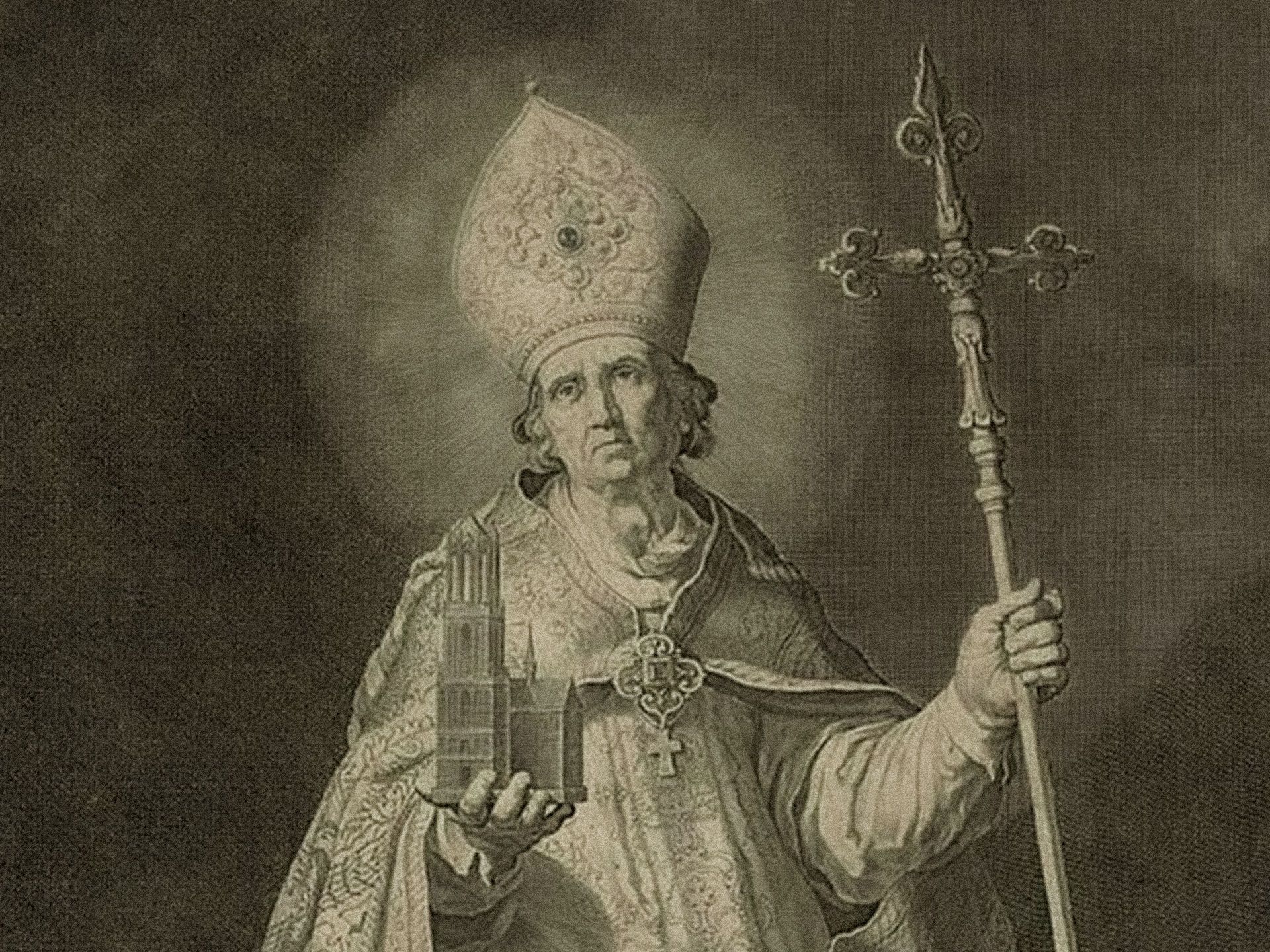
The Beginnings of a Monk
Often called the “Apostle of the Frisians,” Willibrord lived a life of dedication and service in the pursuit of the Great Commission. He was born around 658 in Northumbria, an early English medieval kingdom.
His father, St. Willis, was a hermit who disappeared from society and therefore, sent his son to the Benedictine monastery of Ripon, England where he would grow up and learn the foundations of the faith. Around 677, Willibrord followed the Abbot he was training under in the monastery into exile. In Ireland, he spent 12 years in the Abbey of Rathmelsigi as the disciple of St. Egbert and was ordained as a priest in 688. He desired to be a missionary to the pagans in northern Germany, but was denied due to danger. His call to take the Gospel to these regions was so strong that Willibrord travelled to Rome and begged the pope for permission to brave the danger that no other missionary had survived. The pope granted his request and gave him relics to consecrate altars.
Missionary to the Frisians
In 690, St. Egbert sent Willibrord with 11 others to proselytize the Frisians in the Netherlands. The Frisians, who Willibrord is most well known for evangelizing, are a Germanic group of people native to the North Sea coastal regions of the Netherlands and Germany. Interestingly, the Frisian language is the closest living relative to English. This group of people are also well known for their advanced drainage system such as dikes.
Willibrord had found his calling with the Frisians. Yet, his ministry was widespread. He went to Rome in 690 for a commission from Pope St. Sergius and in 695 received his consecration as archbishop of the Frisians. His authority was now recognized as Apostolic and he continued to expand the good news around the Germanic nations, overthrowing pagan rituals, idols, and proving the truth of Christ. He set up a monastery in Utrecht, Netherlands, where a church grew with his leadership and people were baptized under his preaching.
In 698, Willibrord established a second missionary base, the monastery of Echternach, Luxembourg, which is on the western boarder of Germany. Echternach became the focal point for his missionary activity and was his requested burial site. Today, the abbey is surrounded by a town. Each Tuesday after Pentecost, people gather for a festival known as the Dancing Saints. Participants dance in rhythmic, hopping procession around town to Willibrord’s tomb, where they end with Eucharist. This tradition that has been around since the year 1100 was inscribed by the United Nations Educational, Scientific and Cultural Organization (UNESCO) on the Representative List of the Intangible Cultural Heritage of Humanity in 2010. Participants also perform rituals thought to heal epilepsy and other similar disorders.
Willibrord traveled with his message and attempted to evangelize Denmark. There, he instructed and baptized 30 boys. In 714, he baptized Pepin III the Short, heir to the Merovingian kingdom of the Franks. Pepin greatly supported Willibrord, aiding him as he preached and rebuked idol worship. Sometimes, Willibrord was joined by St. Boniface in their missionary endeavors.
Resistance to the Message
When the pagan Frisian king, Radbod, took the throne, he actively tried to destroy the Christians and exiled Willibrord. Radbod destroyed most of the churches, replacing them with pagan shrines and killing missionaries. Wilibrord traveled during this time, trying to make the most of the providence given to him, but experienced little success.
Upon Radbod’s death in 719, Willibrord returned to rebuild what was lost. He worked with the new Frankish king, Charles Martel, to regain his apostolic authority and had help from St. Boniface to bring back order to the Frankish kingdom through Christian and English influence. Great success was seen through conversions. God was afoot despite the previous destruction.
Legacy
Willibrord influenced the Frankish kingdoms with the Gospel. Though there are no surviving writings attributed to him except some obscure notes, his life left a lasting impact on the culture and religion of Germany and the Netherlands. He introduced the West to the appointment of “country bishops” (bishops of sees under an archbishop, or metropolitan) and brought into the Frankish kingdoms the calendar system of dating by the Christian Era.
Willibrord died on November 7, 739 at age 81. He is buried in the abbey church of Echternach, which is now a place of pilgrimage. He is a patron saint of the Netherlands, Luxembourg, and those who suffer from seizures. He is honored by a feast day on November 7 and wells which he had erected along the routes of his journey are visited to solicit healing of nervous disorders.
Known for his evangelical activity and his dedicated prayer life and meditation, Willibrord laid a foundation of faith for the Germanic nations. His tireless and courageous work to reach the pagans reaped many souls for Christ and continues to impact lives today.