Considerations on Foreign Missions
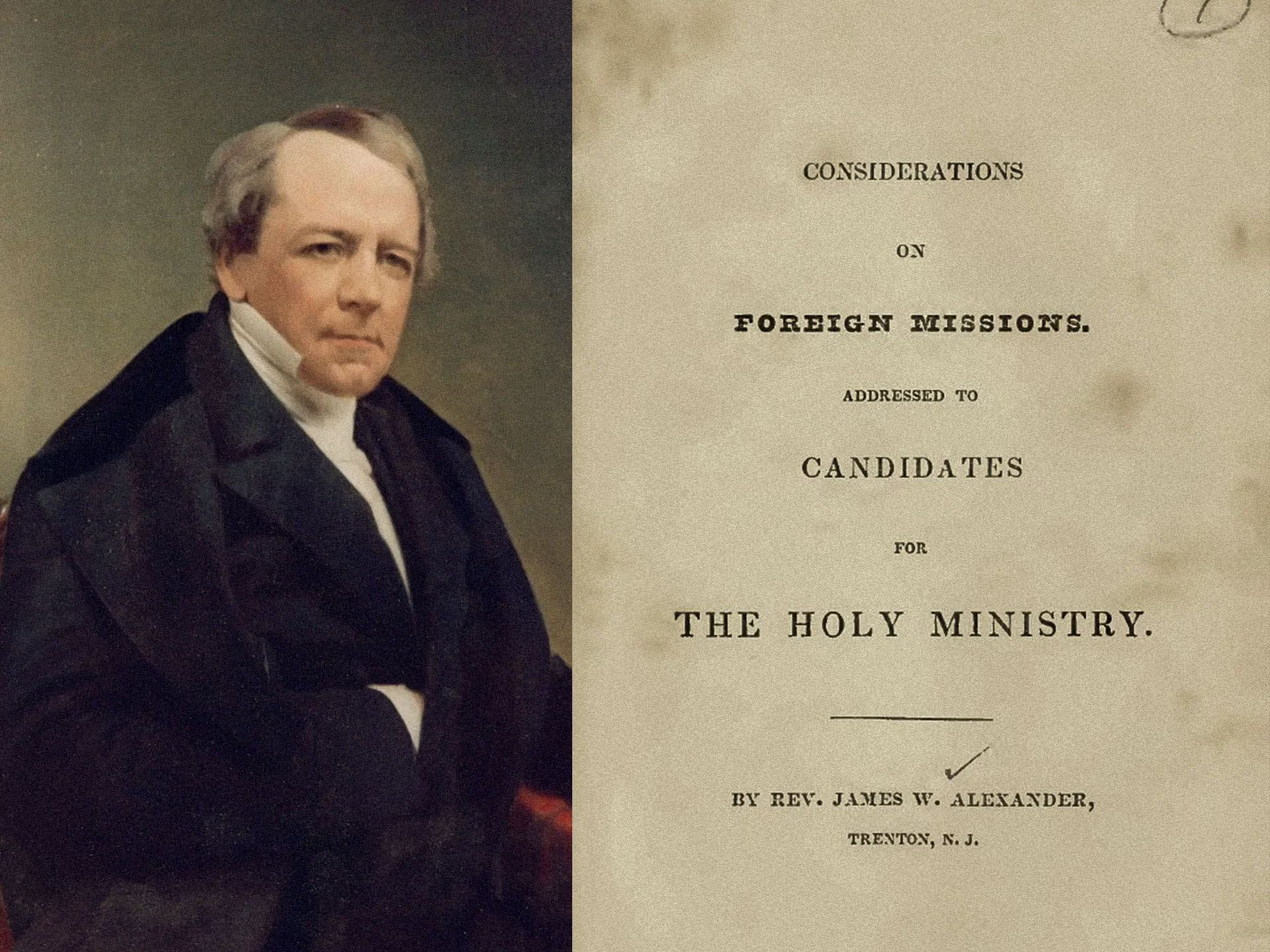
What is the difference between a pastor and a missionary? This is a question many consider when hearing God’s call. It is a question that has been pondered for hundreds of years. One might feel as if going into missions is the more noble option, the option that is harder. They might feel inadequate for the field, and so settle on ministering to the local congregation.
James Waddel Alexander (1804-1859) was a faithful pastor. His father, Archibald Alexander, was also a pastor. James Waddel Alexander wrote many books, including a biography of his father and books for Sunday school classes.
He said this assumption that pastors are separate from missionaries is not how ministers should operate. Those who hear the call should be prepared to go anywhere the Lord will take them, whether that be in their birthplace, or in a country where no one else has gone with the gospel. Read his work, “Considerations on Foreign Missions,” slightly modernized, on the topic.
No one can so forcibly present the claims of Missions as the man who is himself a missionary. Hence there is an urgency in the appeals of Hall, Ward, and Swan, which is almost irresistible. And this might seem to stamp with presumption, if not insincerity, the attempt of a domestic pastor to enlist men for the foreign service. Physician heal thyself, might seem a very natural rejoinder. This, however, is simply a prejudice; and the flaw of the objection is betrayed as soon as we hold it up to the light; for the true ground upon which the claims of Missions should be rested, is the broad foundation of the Christian ministry itself. And therefore every minister is culpable if he has not, even in his most private toils, the spirit of a missionary. He who becomes a pastor, rather than an evangelist, from fear, selfishness, lukewarmness, or pride, is as unfit to preach in the city as in the wilderness.
Candidates for the sacred office are too much accustomed to think thus: "I will prepare myself to serve God as a preacher in my native land, and if I should be specially moved, and loudly called, I will become a foreign missionary." Here there is altogether an error, and an error so great, that we need not be surprised to find him who harbors it, as really unfitted for the ministry at home, as he supposes himself to be for the ministry abroad.
Every candidate for this momentous work should consider himself as dedicated to Christ without reserve or exception; not merely devoted to this or that function, or set apart for the more easy employments of the city, or of refined society, but yielded up to the cause of the Lord Jesus, in the spirit of sacrifice, with no limitation or evasion of his bonds. There is something indescribably attractive in the character of such a youth. He is ready, if the Lord will, to go to the pestilent swamps of Burmah, or to work at the printing presses of Malta, or to endure the still greater self-denials of teaching the American Indians, no less than to display his moving oratory before a listening crowd in the metropolis, or through the press to rouse or melt the community of readers.
A Call to Ministry; a Call to Missions
It would seem that there is an idea prevalent among our young men, that a call to the ministry, and a call to the missionary life, are generically different. This is untrue and dangerous. It is undoubtedly right to expect that the concurrence of circumstances and feelings which go to constitute a call to the foreign service, should differ from those which determine one to stay at home: Yet the service is the same, the cause is the same, the qualifications are the same, and the spirit should be the same. The spirit which led Whitefield to the West, and Martyn to the East, is the same which urged on the labors of Fuller and Payson and Rice; nay, is the very same spirit which leads you into the house of your next neighbor, in order to invite him to Christ. It is the love of God joined with the love of souls. Without this, every minister or candidate is a hypocrite, whose place, unless he repent, must be eternally fixed in hell. And with this genuine characteristic spirit of the gospel, the minister or the candidate is as ready, at the call of his Master, to go abroad, as to remain in his native land. Where there is zeal for the glory of God, and the love of mankind, there is a fitness, so far as mere disposition is regarded, for either work; and he who is without this should make all possible haste to clear himself from the horrible stain of blood, the blood of souls, which will adhere to unfaithful ministers.
Let the candidate for the ministry ask himself this question: "Why do I desire to preach the gospel?" His answer will no doubt be, "Because I desire to glorify God, by the conversion of souls; to obey the commands of Christ; to turn the talents which I possess to the greatest possible advantage in the service of the Lord." Now, if the heart be sincere, if this answer spring from conviction and feeling, there will be in him who utters it an entire, unreserved willingness to labor any where, without exception, without delay, without one pang of reluctance, where God may be honoured and souls saved. You desire to obey the commandment of Christ, and to be a co-worker with God in saving sinners. You desire it without respect to personal ease, compensation, or honor. You seek the ministry, not as a comfortable profession, or a favorable retreat from the noise of the world, in which you may cultivate literature without interruption, but as a painful, trying service, in which a draft will be made upon all your capabilities in order to convert sinners. Your object is to contribute towards the illumination of the whole world. And why is this your desire? What is your authority for so vast an enterprise, so unusual an expectation? The reply is easy; the Lord has said, in language which no repetition makes uninteresting,"Go ye into all the world and preach the gospel to every creature." It is the very commission under which you hope to act. This will be your watchword, even if you labor all your days in some little village of America; and because it is so, because the field of motives urging you to the Ministry has this extent, and no more; because, if you are preacher at all, you must be a preacher under this commission; there is every reason why you should cast down the limitations which fence in your views, and regard the field as the world. The same command which makes you a preacher to your own native town, should make you, if duly called, a preacher to the Aborigines or the Islanders.
The terms which are in common use, contribute to perpetuate an error in many minds. We speak of a missionary as something unique; and draw a broad demarcation between the respective companies of missionaries and ministers. This is not indeed intended, but such is the effect produced. Let it be observed by our youth, that a foreign missionary is a preacher to foreign countries, and nothing else. He is one who would be under no necessity of changing his motives, his feelings, or his zeal in labor, if he were suddenly recalled to the domestic service. On the other hand, the country pastor is a preacher to immortal souls at home, and if he is a faithful man, and acts in pursuance of a divine call, will be entirely ready to leave his charge, and exchange his labors for those of the foreign missionary. In a word, the spirit of missions is the ministerial spirit; and where there is not love for souls sufficiently ardent to make one heartily willing to fly to the succor of the Cherokee or the Tartar, there is not enough of the main thing required in pastors to clear a man's conscience or vindicate his profession. Let it not be supposed, as is too common, that the young student or minister must needs have a certain quantum of holy zeal for Christ, in order to make it possible for him to enter the sacred office without sacrilege, and yet that the ardor and love which would make him a missionary, and would send him to the heathen, is something still beyond this, though excellent, is not required; a mere supererogation, an angelical quality to which only a favored few can hope to attain. Let it not be supposed, to put the caution in a single clause, that you are at liberty to mark the line at which your love of souls shall reach its maximum. A graduating process of this kind may be allowed in trade, in literature, in pleasure, but not in serving Christ. "In this cause we can do nothing aright unless we do all we can. If any one come short of the limits of his ability in aiding this cause, he betrays a criminal indifference which renders all that he does accomplish worthless in the sight of God; and however it may be overruled for good by Him who can make the lukewarmness, as well as the wrath of man to praise Him; yet such a spirit, considered in itself, must be regarded by infinite purity and love with the loathing occasioned by that which is neither cold nor hot."
Cheerful Obedience
The Redeemer must have all; and (blessed be God) not only all that we are and have now, but all that with a still expanding capacity we can ever be, or do. And where is the youth, wounded by the ignominy and misery of sinners, bleeding in secret for the hurt of the daughter of Zion, who can sit down deliberately and make terms with Christ; or say 'thus far will I follow thee, but no farther?' Where is the beloved youth under the patronage of the Church, who can for an instant hesitate as to this entire devotion of himself to her great work—the evangelizing of the world? To prevent misapprehension, let it be remembered, that it is far from the scope of these remarks to insinuate that every preacher should go to the heathen; or that they who stay at home must of necessity be less zealous and devoted than those who go abroad. Nay, it is the error which lies coiled in these expressions, that is now combated. It is attempted to press upon the minds of all candidates that the spirit of the good pastor is identical with the spirit of the good missionary; and that, so far as the spirit is concerned, he who is faithful and efficient in America, would be equally so in the islands of the Pacific; that every candidate for the work of the Ministry should encourage the sentiment, that he is a servant not yet assigned to his field, a soldier awaiting orders; that he has no semblance of a right to determine whither he will go, or whether he will abide at home.
It is high time that the Church should take a more cheerful view of Christian Missions. It is meet that we should no longer speak and think and pray about the voluntary expatriation of a happy Christian group, bound for distant shores, as if it were a dreary exile; a doubtful enterprise; a jeopardy without promise. It is not so. We wrong our dear missionary brethren if we think it so viewed by them. There may be poignancy in the severance of happy ties, especially, as in Martyn's case, where the temperament of the departing evangelist is delicate. And this is that which makes it a self-denial, a cross-bearing. Were there no pangs, there would be no cross to take up. There are minds indeed so coarse and phlegmatic as to pass even such critical moments as these with apathy; but they are not the more likely, from such a complexion, to rejoice with them that do rejoice, and weep with them that weep. The generous heart will gush forth at such an hour; but I have never doubted, that even then, when the last farewell has been said and betokened, when the last headland of the native coast has sunk and vanished, when the freshening breeze has swelled the canvas, and all has conspired to pronounce the divorce from home—I have never doubted that in this hour of unwonted experience there has been a calm after tumult, a sweet serenity of composed reliance, and a filial repose in that Lord whose power is such, "that even the winds and the sea obey him,"—which together indicate a happiness akin to that of heaven.
Sent to Share the Gospel
Yet it is by no means proper that the candidate for the Ministry, especially in the early stages of his course, should definitively choose his field of labor—even though his choice should be the foreign service. Like the cadet who is going through his preparations for military life, without knowing whither he shall be sent upon receiving his commission—the pious student should patiently await the indications of a higher authority. The errors against which he must guard are evidently two. He may precipitately resolve to be a foreign missionary—and this without having any decisive evidence of his fitness for the work. The consequence of such precipitation has, in a number of cases, been, that young men, under the influence of a false impression respecting the mental qualifications required in the missionary life, have neglected their studies, and after all, have retreated from the ground of their original determination. The second error, it must be owned, is far more common. Perhaps a majority of our young ministers have set the question at rest with regard to their own case, by determining that, whatever might be the duty of others, it is theirs to be pastors in their native country. Perhaps a large number have never gravely inquired, as a personal affair, whether the perishing souls of millions of idolaters did not call so loudly upon them, as to make it their duty to become missionaries. Alas! my brethren, how long shall this spirit of slumber endure? How long will you take it for granted, as a matter admitting of no debate, that your duty is to labor at home,—and that while many who have gone out from us are bearing the heat and burden of the day, you may have a dispensation from all services of the kind? The harvest truly is great, the laborers are few; and when you bow your knees in prayer that God would send forth more laborers into his harvest, does it never flash upon your hearts that you are yourselves the very persons to be sent? Have you no sympathy with the awe and contrition and self-renunciation of the prophet, when he cried, 'Here am I, Lord, send me?'
Consider this plain statement of the case. You expect to be preachers of the gospel. You hold yourselves so entirely devoted to this work, that you are willing to go wherever the Lord may send you. You accordingly look around to ask which those regions are, where the gospel is most needed, or where Christ can be most honored. The question is, usually, between civilized America and the heathen—and what are the comparative circumstances of the two? In these United States there is enough of divine truth within the reach of every individual (speaking in general terms) to render him inexcusable in the sight of God, if not to save his soul. Is it so in other lands? There are at least five hundred millions who are idolaters, and one hundred millions who are Mohammedans—not to speak of nominal Christians and infidels! And, as has been well remarked, "we are not to conceive of this vast multitude as collected upon the stage of the world, and standing still, waiting till we are able or disposed to make known to them the way of salvation. They are not standing still; they are moving along the stage; and as thousands of them enter every hour on one side of it, as many disappear on the other side; so that the number perpetually fluctuating is still kept up: but twenty millions of them pass away every year—pass away, and are beyond our reach forever!" Now to him who expects to be invested with the ministerial office, these facts cry aloud with a voice of importunate supplication. And who can look over the brink of such an abyss of horror, and contemplate the agony of everlasting exile from God, as realized by so many sinful fellow men, without "great heaviness," yea even "continual sorrow" in heart? Other men are called to less direct measures and sacrifices— candidates for the ministry are called to give themselves.
Let the proportion be considered, between the six hundred million souls who have never heard of a Savior from sin, and the comparative handful in Christian America who are in similar ignorance—and it will be seen at once, that this is not a question which should be in so summary a way set aside; that it is not self-evident that for one who goes to the heathen, a thousand should remain at home: nay, it will be seen by him who devoutly weighs all the grave considerations which encircle the subject, that there is reason to reconsider all his previous determinations. The question is commonly put in the wrong order, namely, thus—Why should I go on a Foreign Mission? Most plainly it ought to be stated thus—Why am I exempt from the duty of carrying the gospel to perishing millions, when their number is twenty times greater than that of all the real Christians upon earth? To you, then, dear young brethren, who feel that there is a claim upon your best services, founded on the death of Jesus—that there is a solace in Christian charity, which you desire to communicate to the desolate Gentile,—that there is a body of Christians whom your very heart pants to see increased by thousands, it may be said—if there be "any consolation in Christ, if any comfort of love, if any fellowship of the spirit, if any bowels and mercies," fulfil ye the joy of the Church, the joy of Christ, by yielding yourselves to this work. And while we who have gone before you into the Ministry, are struggling with a depressing sense of inefficiency, and stung by conscience for our neglects, do you, in fear of like regrets and compunctions, take that field which no pious missionary has ever yet repented of having sought.
Awake and Go
It is high time to awake out of sleep. The Church is awakening. Contributions are more like the gifts of those who have "first given their own selves unto the Lord;" every year witnesses the increase of missionary candidates in our Seminaries; every Monthly Concert in Prayer is swelled by the accordant notes of new believers. It is time that every probationer, yea, and every settled minister, should hold himself ready to go abroad as an Evangelist; or rather, that the Church had at her disposal, for this work, all the youth whom she may deem it desirable to send. Opposition is dying away. We are no longer repelled by objections to this Apostolic Enterprize; for all are beginning to perceive that no objection can be urged against modern missions which would not have been equally strong against the missions of Paul, Barnabas, and the early preachers. Some there are even now who “please not God, and are contrary to all men; forbidding us to speak to the Gentiles that they might be saved,”—but they are not the friends of Christ or his cause; and we "hope better things of you, and things that accompany salvation."
Concluding Thoughts
A few brief counsels will conclude this essay. Though trite, they are momentous, and the profound consideration of them you will never have cause to regret. For the sake of conciseness they are expressed in the form of exhortation, and this must excuse any thing magisterial in their style. To candidates for the Ministry, then,—whether still abiding under the paternal roof, or pursuing studies in schools, colleges, etc., the friends of missions address themselves with these hints and admonitions:
- Cultivate that desire for the glory of Christ, which is indispensable in the pastor, no less than in the missionary.
- Cherish the sentiment that you are not your own, and that, consequently, you have no right to form any habit, or enter into any engagement, employment, or alliance which could give a bias to your determinations, or throw an obstacle in the way of your zeal. Hold yourself disentangled, and in readiness to meet those calls which the Church is about to make in behalf of the Heathen.
- As the spirit of missions is the spirit of love for souls, imbibe this now—cultivate this temper from day to day, from this very moment, by doing all the good you can to the souls of your relatives, friends, neighbors, dependants, class-mates. If you are fearful, or ashamed of Christ, at the fireside, or in an academy or college—what can you expect to be if called to "speak of his testimonies before kings?"
- Consider yourselves as agents for foreign missions in every company, and rejoice in the opportunity afforded of contributing to the animation of others, and the simultaneous quickening of your own zeal.
Finally. With earnest prayer for direction, let your language be, Lord, what wilt thou have me to do? This petition you may offer with peculiar interest in the expected reply, for "In the whole compass of human benevolence, there is nothing so grand, so noble, so Christian, so truly God-like, as the work of evangelizing the heathen” (Rev. W. Orme).